Every organization will need a living model of itself
Every organization will need a living model of itself

Autonomy is no longer limited by intelligence but by the feedback loop.
An analogy: the simplest version of how an autonomous car works. Its sensors; cameras, LiDAR, and radar, capture signals from the real physical world. The system uses those signals to maintain and continuously update a “world model” of what is happening around it, and to estimate what may happen next. Based on this estimate, it decides what action to take. Then comes the most interesting part. The car receives new signals and compares them with what happened and what it expected. That evidence updates its estimate, influences the next action, and the loop continues. For engineers reading this, this is the basic idea of a closed-loop control system.
Organizations operate through a similar loop, but today most of it exists inside people’s heads. The signals are spread across conversations and systems. The actions are taken by humans and, increasingly, by agents. But the feedback is slow, sparse, and noisy. A decision taken today, or an action not taken today, or a slight strategy change, takes time to reflect back as the outcome, and even then it is hard to establish a correlation between the action and the outcome. A customer may churn months after the decisions that caused it. A project may fail through dozens of interactions across several systems.
Hence, for any organization to move in the direction of being more and more autonomous in nature, it needs two things to establish: (a) a living model of the current state of the organization, updated continuously in real time; and (b) a continuous feedback loop that preserves the action, estimate of outcome measured against the actual outcome.
Though there is an important difference between organizations and the analogy. An autonomous car receives new signals very quickly, and the feedback loop is extremely fast, whereas in organizations it is slow. And that makes living models of an organization even harder to build. That doesn't weaken the case. On the contrary, for any business or organization to survive in the future, it must have a living model and a fast feedback loop established.
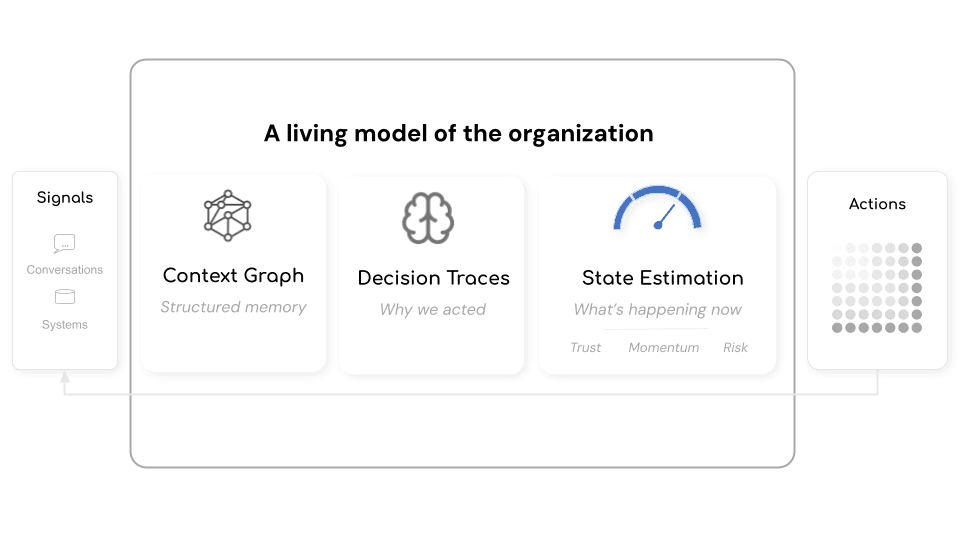
Simplistically, a feedback loop of Observe, Estimate, Act, Measure, and Learn updates the living model continuously and in real time.
An organization is not its systems
Organizations already produce more signals than any person can process. Conversations happen across email, WhatsApp, Slack, and meetings. Work is recorded in CRM, project tools, documents, and financial systems. But these systems do not represent the organization itself. They represent things that happened inside it, not the organization itself. Systems capture what happened; conversations often carry why. The organization is the reality beneath those records. Customer trust strengthens or weakens. Projects gain or lose momentum. Commitments are made, revised, and sometimes forgotten. Teams become aligned or begin operating with different assumptions. None of these properties exists neatly inside a database.
Experienced leaders build this picture for themselves by combining what they hear in meetings, see in systems and remember from earlier decisions. Over time, they develop a working understanding of what is really happening. But that understanding is fragmented, scattered and isolated, and mostly incomplete.
The problem, therefore, is not that organizations lack information. It is that the information never becomes a shared, continuously updated understanding of the organization’s current state. This is not simply a human limitation. It is a computational limitation.
Actions are becoming abundant
Actions through AI and human agents are becoming cheaper, faster and more accurate. Both accuracy and scope of the AI agents will only increase from here. However, abundant actions do not automatically result in better outcomes. The reason is simple: the understanding of shared reality, which decides which action is the best for this customer, situation, and organization’s goal, is just not there. Traditionally, enterprise software was built to record information and automate tasks, but it never participated. We are moving from observe-only to intricate participation in enterprise software.
A system that participates in action accumulates what an observer-only system never sees. Over time, the record of what was tried, in what context and what followed allows the organization to recognize patterns that would have disappeared traditionally.
What is a living model of an organization?
A living model is a shared, evolving representation of the organization: entities, relationships, history, decisions and, most importantly, its current estimated state. It brings together three capabilities.
Context graph provides model structure and continuity by connecting entities, relationships, events, and their temporal context.
Decision traces preserve the history of why: what the organization understood, what options it considered, what it decided and why.
State estimation uses incomplete and changing evidence to infer what may be happening now, including properties such as customer trust, project momentum, alignment and risk.
This distinction matters. A context graph provided structured memory, but it does not by itself determine whether the trust is weakening, momentum is slow or a risk is emerging. Those are estimates of the current state.
The model must also remain connected to action. It should record recommendation, action, expected outcome and actual outcome. These outcomes become new evidence. They may support the earlier estimate, contradict it or leave the result uncertain, but in each case they allow the model to revise its understanding.
That is what makes the model living: it does not simply preserve what the organization knew. It continuously updates what the organization believes is happening.
Autonomy is no longer limited by intelligence but by the feedback loop.
An analogy: the simplest version of how an autonomous car works. Its sensors; cameras, LiDAR, and radar, capture signals from the real physical world. The system uses those signals to maintain and continuously update a “world model” of what is happening around it, and to estimate what may happen next. Based on this estimate, it decides what action to take. Then comes the most interesting part. The car receives new signals and compares them with what happened and what it expected. That evidence updates its estimate, influences the next action, and the loop continues. For engineers reading this, this is the basic idea of a closed-loop control system.
Organizations operate through a similar loop, but today most of it exists inside people’s heads. The signals are spread across conversations and systems. The actions are taken by humans and, increasingly, by agents. But the feedback is slow, sparse, and noisy. A decision taken today, or an action not taken today, or a slight strategy change, takes time to reflect back as the outcome, and even then it is hard to establish a correlation between the action and the outcome. A customer may churn months after the decisions that caused it. A project may fail through dozens of interactions across several systems.
Hence, for any organization to move in the direction of being more and more autonomous in nature, it needs two things to establish: (a) a living model of the current state of the organization, updated continuously in real time; and (b) a continuous feedback loop that preserves the action, estimate of outcome measured against the actual outcome.
Though there is an important difference between organizations and the analogy. An autonomous car receives new signals very quickly, and the feedback loop is extremely fast, whereas in organizations it is slow. And that makes living models of an organization even harder to build. That doesn't weaken the case. On the contrary, for any business or organization to survive in the future, it must have a living model and a fast feedback loop established.
Simplistically, a feedback loop of Observe, Estimate, Act, Measure, and Learn updates the living model continuously and in real time.
An organization is not its systems
Organizations already produce more signals than any person can process. Conversations happen across email, WhatsApp, Slack, and meetings. Work is recorded in CRM, project tools, documents, and financial systems. But these systems do not represent the organization itself. They represent things that happened inside it, not the organization itself. Systems capture what happened; conversations often carry why. The organization is the reality beneath those records. Customer trust strengthens or weakens. Projects gain or lose momentum. Commitments are made, revised, and sometimes forgotten. Teams become aligned or begin operating with different assumptions. None of these properties exists neatly inside a database.
Experienced leaders build this picture for themselves by combining what they hear in meetings, see in systems and remember from earlier decisions. Over time, they develop a working understanding of what is really happening. But that understanding is fragmented, scattered and isolated, and mostly incomplete.
The problem, therefore, is not that organizations lack information. It is that the information never becomes a shared, continuously updated understanding of the organization’s current state. This is not simply a human limitation. It is a computational limitation.
Actions are becoming abundant
Actions through AI and human agents are becoming cheaper, faster and more accurate. Both accuracy and scope of the AI agents will only increase from here. However, abundant actions do not automatically result in better outcomes. The reason is simple: the understanding of shared reality, which decides which action is the best for this customer, situation, and organization’s goal, is just not there. Traditionally, enterprise software was built to record information and automate tasks, but it never participated. We are moving from observe-only to intricate participation in enterprise software.
A system that participates in action accumulates what an observer-only system never sees. Over time, the record of what was tried, in what context and what followed allows the organization to recognize patterns that would have disappeared traditionally.
What is a living model of an organization?
A living model is a shared, evolving representation of the organization: entities, relationships, history, decisions and, most importantly, its current estimated state. It brings together three capabilities.
Context graph provides model structure and continuity by connecting entities, relationships, events, and their temporal context.
Decision traces preserve the history of why: what the organization understood, what options it considered, what it decided and why.
State estimation uses incomplete and changing evidence to infer what may be happening now, including properties such as customer trust, project momentum, alignment and risk.
This distinction matters. A context graph provided structured memory, but it does not by itself determine whether the trust is weakening, momentum is slow or a risk is emerging. Those are estimates of the current state.
The model must also remain connected to action. It should record recommendation, action, expected outcome and actual outcome. These outcomes become new evidence. They may support the earlier estimate, contradict it or leave the result uncertain, but in each case they allow the model to revise its understanding.
That is what makes the model living: it does not simply preserve what the organization knew. It continuously updates what the organization believes is happening.