How to Monitor Account Executives and Reduce Customer Churn with Live NPS
Feb 24, 2026
Introduction
If you're scaling a B2B company, one question becomes critical:
How do you actually know how your account executives are working with customers?
Not what’s written in the CRM.
Not what’s presented in weekly reviews.
Not what gets summarised in dashboards.
But what’s really happening inside customer conversations.
Most customer churn does not happen because of one big failure.
It happens because of multiple small coordination breakdowns that go unnoticed.
In this article, we’ll explore:
How to monitor account executive performance effectively
Why traditional NPS surveys fail to predict churn
What Live NPS is and how it works
How to reduce customer churn using real-time customer health signals
Why Monitoring Account Executives Is So Difficult
The Visibility Gap in Customer Success
Modern work happens inside:
Slack
WhatsApp
Email threads
Calls
Internal group chats
Customer interactions are fragmented.
Most companies attempt to monitor account executive performance using:
CRM updates
Task completion rates
Revenue numbers
Quarterly NPS surveys
But these systems measure outputs — not execution quality.
They don’t answer:
Was the follow-up actually closed?
Did escalation signals appear earlier?
Is ownership drifting between teams?
Are customers repeating the same complaints?
This creates a visibility gap.
And visibility gaps create churn.
The Real Reason Customers Leave: Invisible Execution Failures
Many founders believe churn happens due to:
Pricing issues
Product gaps
Budget cuts
Competition
But in reality, churn often results from coordination failure.
Small failures such as:
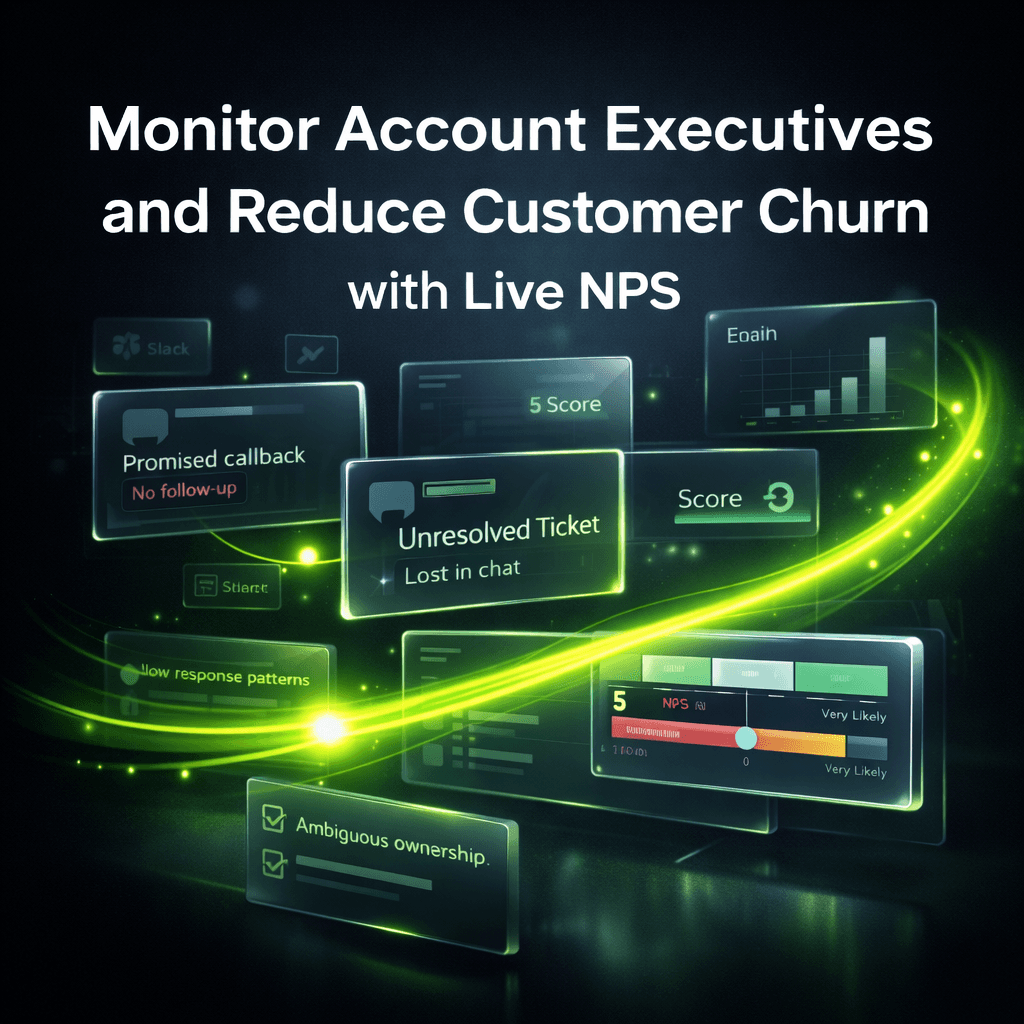
Promised callbacks not made
Unresolved tickets buried in chat
Ambiguous ownership
Escalations mentioned but not formalized
Slow response patterns
Each event is minor.
But together, they create silent dissatisfaction.
By the time traditional NPS detects it, it's already too late.
Why Traditional NPS Surveys Fail to Predict Churn
NPS is a Lagging Indicator
If you want a quick refresher on what NPS measures, and where it breaks
read: Beyond the Score: Understanding NPS and What Comes Next
Net Promoter Score (NPS) surveys ask:
“How likely are you to recommend us?”
The problem?
It measures sentiment after damage has occurred.
It does not show:
Which account executive dropped execution loops
Where operational risk first appeared
When customer health started declining
Which account needs proactive intervention
NPS surveys are reactive.
Churn prevention requires proactive systems.
What Is Live NPS?
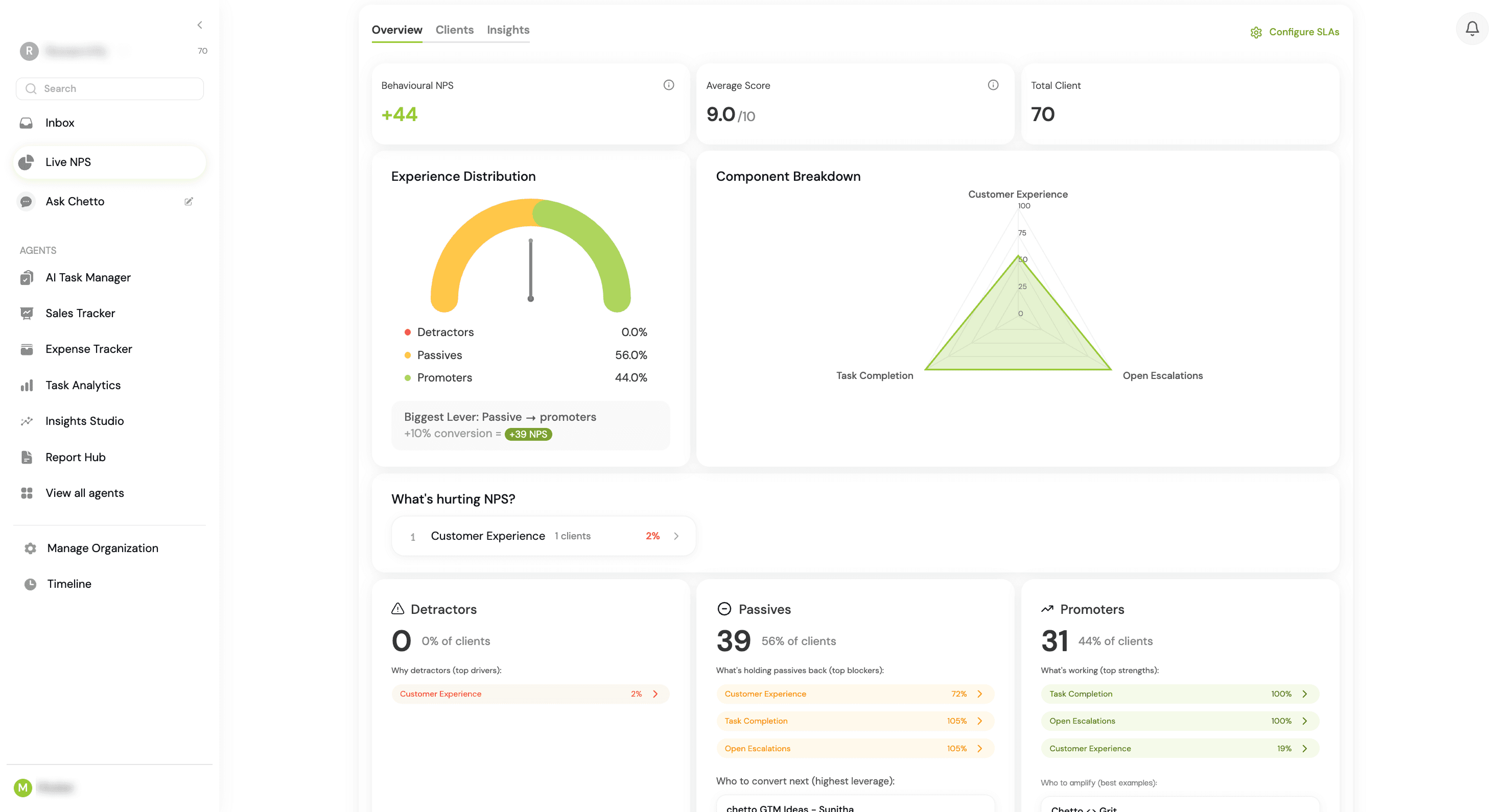
Live NPS is a real-time customer health score derived from operational signals, not surveys.
Instead of asking customers how they feel, Live NPS analyzes how the system behaves.
At Chetto, Live NPS is built from signals such as:
Escalation frequency
Response time trends
Repeated complaint patterns
Commitment closure rate
Ownership clarity
Cross-team dependency friction
These signals generate a continuous customer health score.
This enables companies to:
Identify at-risk accounts early
Monitor account executive performance objectively
Reduce customer churn before it happens
Improve customer retention without increasing headcount
How to Monitor Account Executives Effectively
If you're trying to monitor account executives, focus on execution signals, not just revenue metrics.
Key Metrics That Actually Matter
Commitment Closure Rate
% of promises delivered within expected timeframe
Escalation Density
Number of escalation-related messages per account
Response Time Stability
Is response time deteriorating over time?
Ownership Drift
Are multiple people handling the same issue without clarity?
Repeated Issue Frequency
Are customers raising similar concerns repeatedly?
These metrics give visibility into customer success quality.
They are far more predictive of churn than quarterly surveys.
How Live NPS Reduces Customer Churn
Customer churn is rarely sudden.
It builds gradually.
Live NPS reduces churn by:
Surfacing early warning signals
Prioritizing at-risk accounts
Enabling proactive intervention
Coaching underperforming account executives
Highlighting operational bottlenecks
Instead of asking:
“Why did this customer churn?”
You start asking:
“Which signal moved first?”
That shift is transformative.
Scaling Without Increasing Headcount
Many companies respond to churn by hiring more customer success managers.
But scaling headcount linearly is not sustainable.
Live NPS allows you to:
Focus attention where risk is highest
Allocate resources intelligently
Automate visibility
Reduce manual reporting overhead
This enables scalable growth.
The goal is simple:
Eliminate non-voluntary churn without linearly increasing sales and support teams.
Customer Health Is a System Design Problem
If you cannot see execution risk, you cannot manage it.
Modern customer success requires:
Structured visibility into conversations
Real-time signal extraction
Early risk detection
Loop closure tracking
Customer retention is not a survey problem.
It is a systems problem.
And systems require signal intelligence.
Final Thoughts: Rethinking Account Executive Monitoring
If you're a founder or revenue leader, ask yourself:
Do I truly know how my account executives are working with customers?
Or do I only know what gets reported?
The difference determines whether churn feels random —
or predictable and preventable.
Live NPS transforms customer health from a quarterly surprise into a measurable, real-time signal.
And that’s how you scale sustainably.