Your Clients are Escalating you just cannot see it
Your Clients are Escalating you just cannot see it
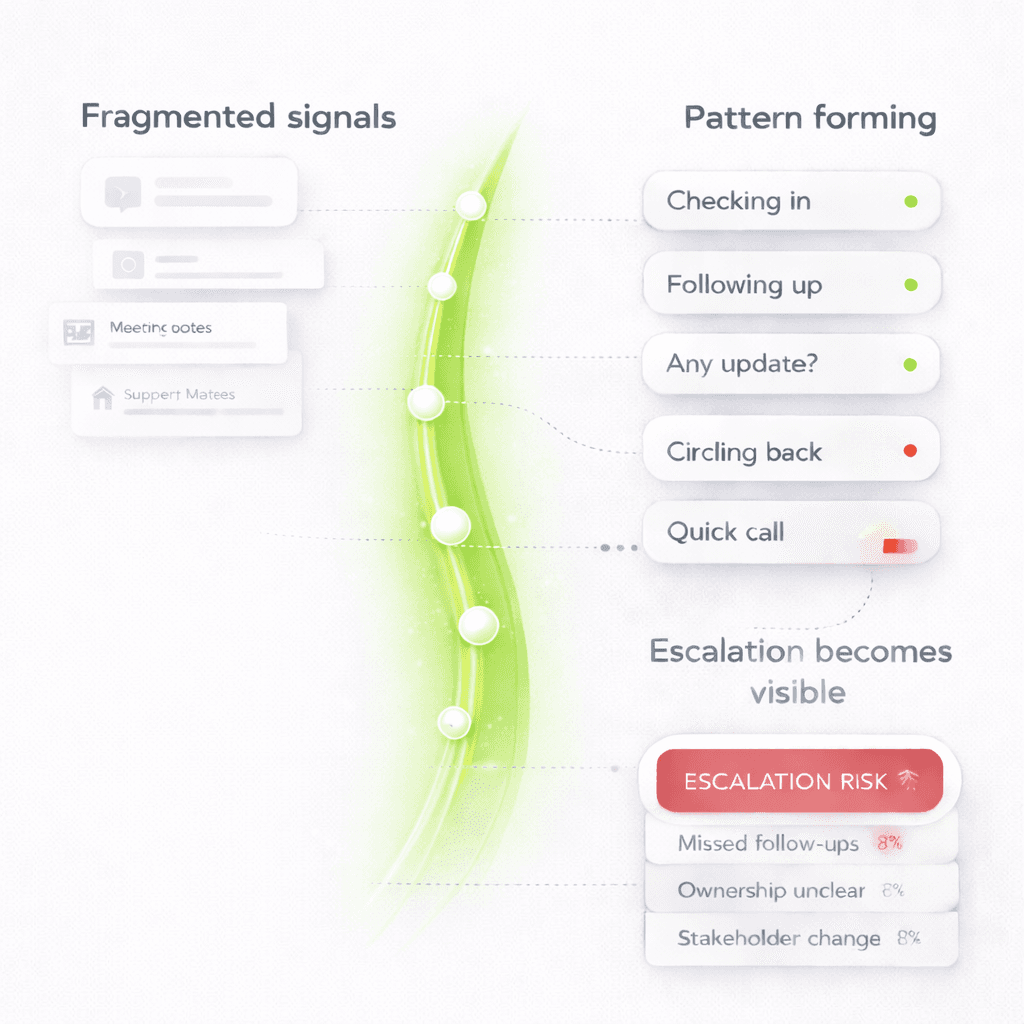
Most customer escalations do not begin with a message that says, “This is an escalation.”
They begin quietly.
A stakeholder who suddenly joins the next call.
A customer who starts replying with one-line messages.
A thread that shifts from collaborative to corrective.
A follow-up that slips by because it lived in someone’s inbox, someone else’s Slack, and nowhere your team could actually see end-to-end.
That is what makes escalations dangerous. They usually do not arrive as a formal event. They build as a pattern.
And the pattern is easier to miss than most teams think.
In Qualtrics XM Institute’s 2025 global consumer study, 12% of recent customer experiences were rated “very poor.” More importantly, communication problems were cited in 45% of bad experiences, nearly matching service delivery issues at 46%. Over half of negative experiences led customers to reduce or stop spending with the organization. In other words: bad experiences are not just operational failures. Very often, they are communication failures, and they show up in revenue quickly.
Escalations start long before they are named
By the time a customer formally escalates, the relationship has usually been under strain for a while.
There were missed follow-ups. Repeated clarifications. A question that got answered, but not really resolved. A promise that changed hands without clear ownership. A call where the tone changed, but nobody captured it anywhere useful.
This is the part most teams underestimate: escalation is often not a moment. It is a sequence.
That matters because if you are only tracking tickets, renewals, or explicit complaints, you are already late. Formal escalation is usually the visible result of invisible drift.
PwC found that 32% of customers would stop doing business with a brand they loved after just one bad experience, and 59% would walk away after several bad experiences. The tolerance window is smaller than many teams assume. (PwC)
Silence is not a sign that everything is fine
One of the most useful ideas from complaint - behaviour research is also one of the most uncomfortable: many unhappy customers do not complain directly.
A well-cited study on “non complainers” defines them as customers who experience service failures but do not voice complaints. Another study notes that in service failures, firms should encourage customers to voice concerns directly rather than remain silent, exit, or spread negative word of mouth, and adds that the majority of customers still choose not to voice. (Springer)
That is the trap.
Teams often treat the absence of an escalation as proof of customer health. But silence can mean something else entirely: the customer has lost confidence that speaking up will help, or they are already discussing alternatives internally.
The account may look “stable” in the CRM while frustration is spreading in side conversations your team cannot see.
Why teams miss escalations
The answer is usually not that teams do not care.
It is that the signal is fragmented.
One person sees the unanswered email.
Another hears the frustration on a call.
Someone in support notices a sharper tone.
The account owner feels the relationship cooling, but cannot point to one obvious event.
Leadership only gets involved once the customer says the word “escalation.”
By then, the pattern has already matured.
This is the real customer visibility gap. The problem is not only that communication is happening across email, Slack, WhatsApp, meeting notes, and support channels. The problem is that escalation signals are distributed across all of them, while ownership is distributed across people.
No single person sees the whole story early enough.
What hidden escalation actually looks like
It looks like repetition.
The customer repeats a concern that should already be known. They ask who owns something more than once. Their replies get shorter. New stakeholders appear without context. Meetings become more frequent, but less productive. Commitments become vaguer. Your team starts using phrases like “just checking in,” “circling back,” and “following up again.”
These are not random communication quirks. Together, they are often early warning signs of customer risk, client escalations, or churn.
And this is exactly why reactive escalation management is not enough anymore. Teams need a way to detect pattern change, not just record incidents.
What better escalation management looks like
It looks proactive.
Microsoft’s Global State of Customer Service report found that 90% of customers say customer service is important to their choice of and loyalty to a brand. The same report found that 58% show little hesitation in severing the relationship when expectations fall short, and 67% view proactive customer-service notifications favorably. Customers do not just want problems fixed. They want to feel that you saw the problem early and moved before they had to push.
That is the shift: from managing escalations after they become visible to detecting escalation signals while they are still diffuse.
This is where conversation intelligence matters
If your customer reality lives inside conversations, your escalation signals do too.
You are not going to catch them reliably with status fields alone. You need visibility into how communication is changing across channels, where follow-ups are slipping, where ownership is unclear, and where the tone of an account is starting to deteriorate before the customer makes it official.
That is what conversation intelligence should do.
Not just summarize conversations. Not just log activity. But help teams see risk earlier: missed follow-ups, unresolved threads, repeated concerns, stakeholder shifts, and the subtle language patterns that often precede formal customer escalation.
Because the goal is not to manage escalations better once they explode.
The goal is to spot them while they still look like “nothing serious.”
That is the window where relationships are still recoverable.
And for most teams, that is the window they are missing.
Chetto helps teams see the escalation signals buried in customer conversations across channels — from missed follow-ups to shifting tone, unclear ownership, and repeated concerns — so teams can act before churn risk becomes a formal escalation.
1.What is conversation intelligence?
Conversation intelligence uses AI to analyze business communication/conversations across calls, meetings, emails, chats, and customer interactions to surface actionable insight such as ownership, risk, follow-ups, and next steps.
2. What does customer escalation mean?
Customer escalation means a customer issue, frustration, or unresolved concern has grown serious enough to require urgent attention or involvement from senior team members. In many cases, customer escalations start before they are formally named, showing up first as repeated follow-ups, delayed responses, or unresolved communication across channels.
3. What are the early warning signs of customer churn or client escalation?
Early warning signs of customer churn or client escalation can include shorter replies, repeated clarifications, missed follow-ups, unclear ownership, new stakeholders joining the conversation, and customers raising the same issue multiple times. These signals often appear quietly across email, Slack, WhatsApp, and meetings before they become a formal escalation.
4. How can teams prevent client escalations?
Teams can prevent client escalations by spotting risk early across customer conversations, not just by tracking support tickets or CRM updates. Better visibility into follow-up gaps, unresolved threads, shifting sentiment, and stakeholder changes helps teams act sooner, improve response time, and reduce the chances of churn or escalation.
Read more about our product here

Blog written by
Muskan Dhadda
Product Designer
Muskan Dhadda is a product designer with a strong interest in user experience, systems thinking, and thoughtful visual design. She enjoys understanding the “why” behind products and turning ideas, patterns, and complexity into clear, practical experiences.
Blog written by
Muskan Dhadda
Product Designer
Muskan Dhadda is a product designer with a strong interest in user experience, systems thinking, and thoughtful visual design. She enjoys understanding the “why” behind products and turning ideas, patterns, and complexity into clear, practical experiences.
Most customer escalations do not begin with a message that says, “This is an escalation.”
They begin quietly.
A stakeholder who suddenly joins the next call.
A customer who starts replying with one-line messages.
A thread that shifts from collaborative to corrective.
A follow-up that slips by because it lived in someone’s inbox, someone else’s Slack, and nowhere your team could actually see end-to-end.
That is what makes escalations dangerous. They usually do not arrive as a formal event. They build as a pattern.
And the pattern is easier to miss than most teams think.
In Qualtrics XM Institute’s 2025 global consumer study, 12% of recent customer experiences were rated “very poor.” More importantly, communication problems were cited in 45% of bad experiences, nearly matching service delivery issues at 46%. Over half of negative experiences led customers to reduce or stop spending with the organization. In other words: bad experiences are not just operational failures. Very often, they are communication failures, and they show up in revenue quickly.
Escalations start long before they are named
By the time a customer formally escalates, the relationship has usually been under strain for a while.
There were missed follow-ups. Repeated clarifications. A question that got answered, but not really resolved. A promise that changed hands without clear ownership. A call where the tone changed, but nobody captured it anywhere useful.
This is the part most teams underestimate: escalation is often not a moment. It is a sequence.
That matters because if you are only tracking tickets, renewals, or explicit complaints, you are already late. Formal escalation is usually the visible result of invisible drift.
PwC found that 32% of customers would stop doing business with a brand they loved after just one bad experience, and 59% would walk away after several bad experiences. The tolerance window is smaller than many teams assume. (PwC)
Silence is not a sign that everything is fine
One of the most useful ideas from complaint - behaviour research is also one of the most uncomfortable: many unhappy customers do not complain directly.
A well-cited study on “non complainers” defines them as customers who experience service failures but do not voice complaints. Another study notes that in service failures, firms should encourage customers to voice concerns directly rather than remain silent, exit, or spread negative word of mouth, and adds that the majority of customers still choose not to voice. (Springer)
That is the trap.
Teams often treat the absence of an escalation as proof of customer health. But silence can mean something else entirely: the customer has lost confidence that speaking up will help, or they are already discussing alternatives internally.
The account may look “stable” in the CRM while frustration is spreading in side conversations your team cannot see.
Why teams miss escalations
The answer is usually not that teams do not care.
It is that the signal is fragmented.
One person sees the unanswered email.
Another hears the frustration on a call.
Someone in support notices a sharper tone.
The account owner feels the relationship cooling, but cannot point to one obvious event.
Leadership only gets involved once the customer says the word “escalation.”
By then, the pattern has already matured.
This is the real customer visibility gap. The problem is not only that communication is happening across email, Slack, WhatsApp, meeting notes, and support channels. The problem is that escalation signals are distributed across all of them, while ownership is distributed across people.
No single person sees the whole story early enough.
What hidden escalation actually looks like
It looks like repetition.
The customer repeats a concern that should already be known. They ask who owns something more than once. Their replies get shorter. New stakeholders appear without context. Meetings become more frequent, but less productive. Commitments become vaguer. Your team starts using phrases like “just checking in,” “circling back,” and “following up again.”
These are not random communication quirks. Together, they are often early warning signs of customer risk, client escalations, or churn.
And this is exactly why reactive escalation management is not enough anymore. Teams need a way to detect pattern change, not just record incidents.
What better escalation management looks like
It looks proactive.
Microsoft’s Global State of Customer Service report found that 90% of customers say customer service is important to their choice of and loyalty to a brand. The same report found that 58% show little hesitation in severing the relationship when expectations fall short, and 67% view proactive customer-service notifications favorably. Customers do not just want problems fixed. They want to feel that you saw the problem early and moved before they had to push.
That is the shift: from managing escalations after they become visible to detecting escalation signals while they are still diffuse.
This is where conversation intelligence matters
If your customer reality lives inside conversations, your escalation signals do too.
You are not going to catch them reliably with status fields alone. You need visibility into how communication is changing across channels, where follow-ups are slipping, where ownership is unclear, and where the tone of an account is starting to deteriorate before the customer makes it official.
That is what conversation intelligence should do.
Not just summarize conversations. Not just log activity. But help teams see risk earlier: missed follow-ups, unresolved threads, repeated concerns, stakeholder shifts, and the subtle language patterns that often precede formal customer escalation.
Because the goal is not to manage escalations better once they explode.
The goal is to spot them while they still look like “nothing serious.”
That is the window where relationships are still recoverable.
And for most teams, that is the window they are missing.
Chetto helps teams see the escalation signals buried in customer conversations across channels — from missed follow-ups to shifting tone, unclear ownership, and repeated concerns — so teams can act before churn risk becomes a formal escalation.
1.What is conversation intelligence?
Conversation intelligence uses AI to analyze business communication/conversations across calls, meetings, emails, chats, and customer interactions to surface actionable insight such as ownership, risk, follow-ups, and next steps.
2. What does customer escalation mean?
Customer escalation means a customer issue, frustration, or unresolved concern has grown serious enough to require urgent attention or involvement from senior team members. In many cases, customer escalations start before they are formally named, showing up first as repeated follow-ups, delayed responses, or unresolved communication across channels.
3. What are the early warning signs of customer churn or client escalation?
Early warning signs of customer churn or client escalation can include shorter replies, repeated clarifications, missed follow-ups, unclear ownership, new stakeholders joining the conversation, and customers raising the same issue multiple times. These signals often appear quietly across email, Slack, WhatsApp, and meetings before they become a formal escalation.
4. How can teams prevent client escalations?
Teams can prevent client escalations by spotting risk early across customer conversations, not just by tracking support tickets or CRM updates. Better visibility into follow-up gaps, unresolved threads, shifting sentiment, and stakeholder changes helps teams act sooner, improve response time, and reduce the chances of churn or escalation.
Read more about our product here
Blog written by
Muskan Dhadda
Product Designer
Muskan Dhadda is a product designer with a strong interest in user experience, systems thinking, and thoughtful visual design. She enjoys understanding the “why” behind products and turning ideas, patterns, and complexity into clear, practical experiences.