How to Manage Customer Conversations Across Email, Slack, WhatsApp, and Google Meet
How to Manage Customer Conversations Across Email, Slack, WhatsApp, and Google Meet
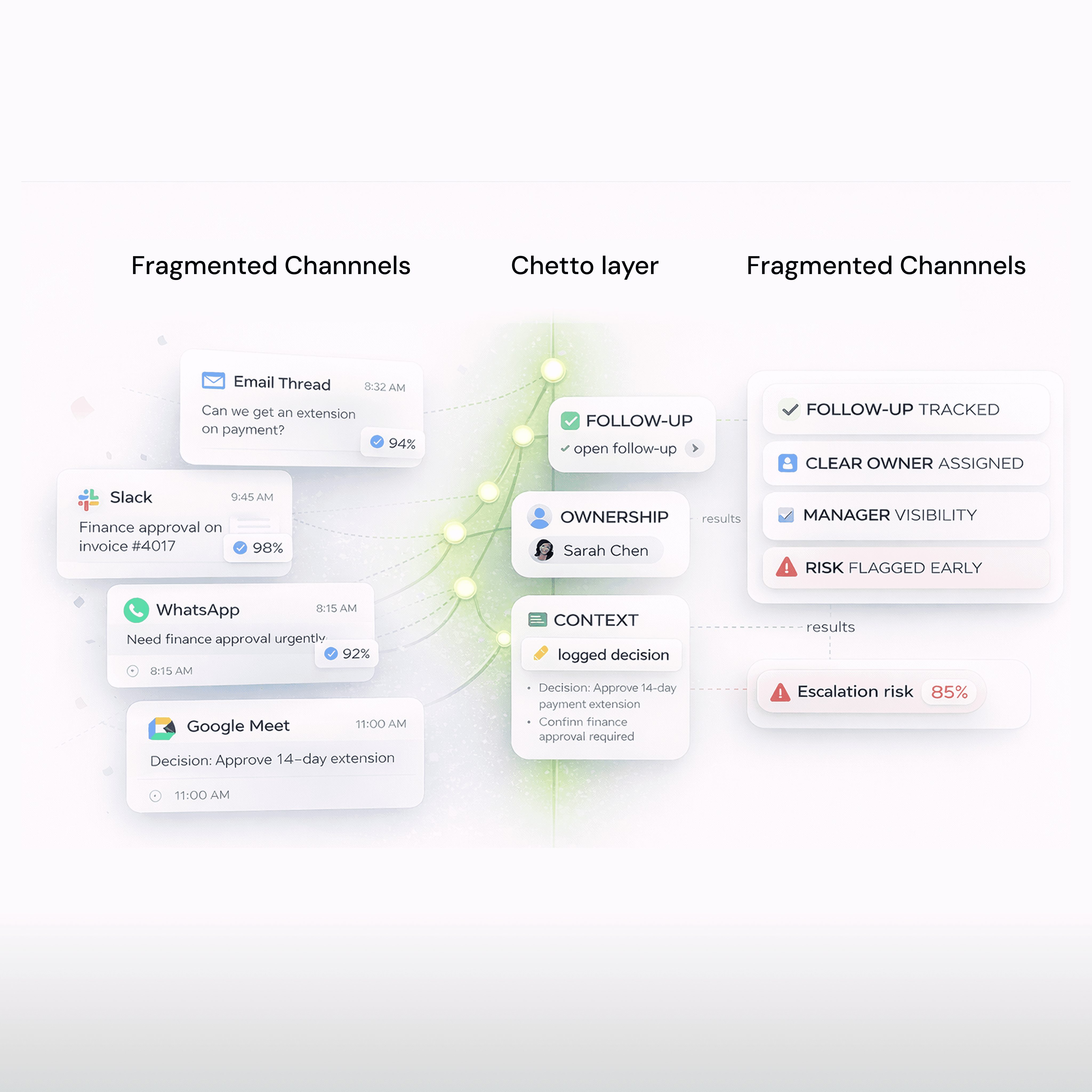
Customer communication rarely happens in one place.
It moves across email, Slack, WhatsApp, and Google Meet. A customer message starts in one channel, context gets discussed in another, a decision gets made in a meeting, and the follow-up is expected somewhere else.
That is where teams start losing visibility.
The problem is not that businesses use multiple tools.
The problem is that customer communication gets fragmented across them.
A customer asks for an update on email.
An internal discussion happens on Slack.
A quick clarification happens on WhatsApp.
A decision is made in Google Meet.
No one has the complete picture.
This is the challenge Chetto is built to solve.
Chetto helps teams manage customer conversations across channels by bringing visibility, ownership, follow-up tracking, and context continuity into the workflows they already use.
The real problem with multichannel customer communication
Most teams do not struggle because they lack communication.
They struggle because communication is scattered.
The same customer relationship may involve:
external updates on email
internal coordination on Slack
quick operational messages on WhatsApp
decisions and next steps discussed in Google Meet
When these interactions stay disconnected, businesses start running into the same operational problems again and again.
Pain point 1: Follow-ups get missed
This is one of the most common breakdowns in customer communication.
Someone replies.
A next step is promised.
The conversation moves to another channel.
The follow-up never happens.
Missed follow-ups do not always look serious at first. But over time, they damage trust, slow execution, and make customers feel ignored.
When communication is spread across multiple tools, it becomes much harder to know:
what is still pending
who is supposed to respond
which customer is waiting on an update
which issues are slipping through
Chetto helps teams track follow-ups across channels so communication does not disappear between email, Slack, WhatsApp, and meetings.
Pain point 2: Ownership is unclear
In multi-channel workflows, ownership often breaks down quietly.
A customer issue may be visible to several people.
An internal discussion may happen in Slack.
A response may go out on email.
A meeting may end with a loose verbal agreement.
But who actually owns the next step?
Without clear ownership, teams deal with:
duplicate responses
unanswered conversations
broken handoffs
unresolved issues
confusion across departments
Chetto helps teams bring assignment logic and accountability into customer communication, so every important thread has clearer ownership.
Pain point 3: Managers lack visibility
One of the biggest problems in customer-facing teams is not response volume.
It is lack of oversight.
When conversations are scattered across channels and individual team habits, managers struggle to answer simple questions:
What is happening with this customer?
Has someone responded?
Was the issue resolved?
Which conversations are at risk?
Which teams or branches are missing follow-ups?
This becomes even harder when different branches, account managers, or functions handle communication differently.
Chetto helps create visibility across communication workflows so managers can understand what is happening without reconstructing the full story manually.
Pain point 4: Meeting context gets lost
A lot of important customer communication does not happen in written messages.
It happens in meetings.
A commitment is made in Google Meet.
A customer concern is explained in detail on a call.
A decision is made verbally.
A next step is understood in the room, but never clearly tracked afterward.
That creates a major gap.
The team may remember the outcome for a while, but the context behind the decision often disappears. Then later, execution slows down because nobody has a reliable record of what was agreed.
Chetto helps connect meeting context with the rest of the communication workflow, so teams do not lose important decisions between calls, email threads, and chat.
Pain point 5: Customer context is fragmented across tools
The biggest operational issue is not the existence of multiple channels.
It is the lack of continuity across them.
A team may know pieces of the story, but not the full picture.
One person sees the email thread.
Another sees the Slack discussion.
Someone else joined the Google Meet call.
A quick update came through on WhatsApp.
The result is fragmented context.
This leads to slower decisions, inconsistent responses, and more reactive execution.
Chetto helps teams treat communication across channels as part of one connected workflow instead of separate systems that need to be stitched together by memory.
Pain point 6: Risks appear in conversations before they appear in systems
Many business risks show up first in communication.
A customer repeats the same concern.
A promised update gets delayed.
An internal blocker is discussed in Slack.
A meeting reveals hesitation or urgency.
A conversation starts to show signs of dissatisfaction.
These early signals often stay buried because teams are focused on replying, not interpreting patterns across channels.
Chetto helps make these signals more visible so teams can act earlier instead of waiting for a bigger escalation.
What Chetto offers with conversation intellignece
Chetto is built for teams that need to manage customer communication across email, Slack, WhatsApp, and Google Meet without changing the way they already work.
It helps organisations:
Track follow-ups across channels
Maintain clearer ownership
Improve manager visibility
Preserve context between messages and meetings
Reduce fragmentation in customer communication
Identify operational risk earlier
Work from a more connected communication layer
This is not about replacing the tools teams already use.
It is about making those tools work better together.
Why this matters for customer-facing teams
Sales, support, customer success, and operations teams all depend on communication quality.
When communication is fragmented, teams become reactive.
When communication is connected, teams can work with more continuity.
That means:
fewer missed follow-ups
better accountability
clearer handoffs
stronger visibility
faster intervention when something starts going wrong
This is where multichannel customer communication management becomes valuable in practice.
Final thought
Customer communication does not live in one inbox anymore.
It lives across email, Slack, WhatsApp, and Google Meet, with context constantly moving between external messages, internal discussion, and meetings.
That is why teams need more than message storage.
They need a way to manage conversations across channels with better visibility, clearer ownership, and stronger follow-up tracking.
That is the problem Chetto is built to solve.
FAQ
What is conversation intelligence?
Conversation intelligence uses AI to analyze business communication/conversations across calls, meetings, emails, chats, and customer interactions to surface actionable insight such as ownership, risk, follow-ups, and next steps.
How do you manage customer conversations across multiple channels?
You need a system that helps connect communication across email, Slack, WhatsApp, and meetings so teams can track follow-ups, ownership, decisions, and risk in one workflow.
Why do teams miss follow-ups across channels?
Because communication often moves between email, chat, messaging apps, and meetings. When no system connects those channels, follow-ups easily get lost.
How do you keep ownership clear in multichannel communication?
Teams need assignment logic and visibility so every important conversation has a clear owner.
Unified inbox for conversations → Read blog here
Detect churn signals earlier → Read blog here

Blog written by
Muskan Dhadda
Product Designer
Muskan Dhadda is a product designer with a strong interest in user experience, systems thinking, and thoughtful visual design. She enjoys understanding the “why” behind products and turning ideas, patterns, and complexity into clear, practical experiences.
Blog written by
Muskan Dhadda
Product Designer
Muskan Dhadda is a product designer with a strong interest in user experience, systems thinking, and thoughtful visual design. She enjoys understanding the “why” behind products and turning ideas, patterns, and complexity into clear, practical experiences.
Customer communication rarely happens in one place.
It moves across email, Slack, WhatsApp, and Google Meet. A customer message starts in one channel, context gets discussed in another, a decision gets made in a meeting, and the follow-up is expected somewhere else.
That is where teams start losing visibility.
The problem is not that businesses use multiple tools.
The problem is that customer communication gets fragmented across them.
A customer asks for an update on email.
An internal discussion happens on Slack.
A quick clarification happens on WhatsApp.
A decision is made in Google Meet.
No one has the complete picture.
This is the challenge Chetto is built to solve.
Chetto helps teams manage customer conversations across channels by bringing visibility, ownership, follow-up tracking, and context continuity into the workflows they already use.
The real problem with multichannel customer communication
Most teams do not struggle because they lack communication.
They struggle because communication is scattered.
The same customer relationship may involve:
external updates on email
internal coordination on Slack
quick operational messages on WhatsApp
decisions and next steps discussed in Google Meet
When these interactions stay disconnected, businesses start running into the same operational problems again and again.
Pain point 1: Follow-ups get missed
This is one of the most common breakdowns in customer communication.
Someone replies.
A next step is promised.
The conversation moves to another channel.
The follow-up never happens.
Missed follow-ups do not always look serious at first. But over time, they damage trust, slow execution, and make customers feel ignored.
When communication is spread across multiple tools, it becomes much harder to know:
what is still pending
who is supposed to respond
which customer is waiting on an update
which issues are slipping through
Chetto helps teams track follow-ups across channels so communication does not disappear between email, Slack, WhatsApp, and meetings.
Pain point 2: Ownership is unclear
In multi-channel workflows, ownership often breaks down quietly.
A customer issue may be visible to several people.
An internal discussion may happen in Slack.
A response may go out on email.
A meeting may end with a loose verbal agreement.
But who actually owns the next step?
Without clear ownership, teams deal with:
duplicate responses
unanswered conversations
broken handoffs
unresolved issues
confusion across departments
Chetto helps teams bring assignment logic and accountability into customer communication, so every important thread has clearer ownership.
Pain point 3: Managers lack visibility
One of the biggest problems in customer-facing teams is not response volume.
It is lack of oversight.
When conversations are scattered across channels and individual team habits, managers struggle to answer simple questions:
What is happening with this customer?
Has someone responded?
Was the issue resolved?
Which conversations are at risk?
Which teams or branches are missing follow-ups?
This becomes even harder when different branches, account managers, or functions handle communication differently.
Chetto helps create visibility across communication workflows so managers can understand what is happening without reconstructing the full story manually.
Pain point 4: Meeting context gets lost
A lot of important customer communication does not happen in written messages.
It happens in meetings.
A commitment is made in Google Meet.
A customer concern is explained in detail on a call.
A decision is made verbally.
A next step is understood in the room, but never clearly tracked afterward.
That creates a major gap.
The team may remember the outcome for a while, but the context behind the decision often disappears. Then later, execution slows down because nobody has a reliable record of what was agreed.
Chetto helps connect meeting context with the rest of the communication workflow, so teams do not lose important decisions between calls, email threads, and chat.
Pain point 5: Customer context is fragmented across tools
The biggest operational issue is not the existence of multiple channels.
It is the lack of continuity across them.
A team may know pieces of the story, but not the full picture.
One person sees the email thread.
Another sees the Slack discussion.
Someone else joined the Google Meet call.
A quick update came through on WhatsApp.
The result is fragmented context.
This leads to slower decisions, inconsistent responses, and more reactive execution.
Chetto helps teams treat communication across channels as part of one connected workflow instead of separate systems that need to be stitched together by memory.
Pain point 6: Risks appear in conversations before they appear in systems
Many business risks show up first in communication.
A customer repeats the same concern.
A promised update gets delayed.
An internal blocker is discussed in Slack.
A meeting reveals hesitation or urgency.
A conversation starts to show signs of dissatisfaction.
These early signals often stay buried because teams are focused on replying, not interpreting patterns across channels.
Chetto helps make these signals more visible so teams can act earlier instead of waiting for a bigger escalation.
What Chetto offers with conversation intellignece
Chetto is built for teams that need to manage customer communication across email, Slack, WhatsApp, and Google Meet without changing the way they already work.
It helps organisations:
Track follow-ups across channels
Maintain clearer ownership
Improve manager visibility
Preserve context between messages and meetings
Reduce fragmentation in customer communication
Identify operational risk earlier
Work from a more connected communication layer
This is not about replacing the tools teams already use.
It is about making those tools work better together.
Why this matters for customer-facing teams
Sales, support, customer success, and operations teams all depend on communication quality.
When communication is fragmented, teams become reactive.
When communication is connected, teams can work with more continuity.
That means:
fewer missed follow-ups
better accountability
clearer handoffs
stronger visibility
faster intervention when something starts going wrong
This is where multichannel customer communication management becomes valuable in practice.
Final thought
Customer communication does not live in one inbox anymore.
It lives across email, Slack, WhatsApp, and Google Meet, with context constantly moving between external messages, internal discussion, and meetings.
That is why teams need more than message storage.
They need a way to manage conversations across channels with better visibility, clearer ownership, and stronger follow-up tracking.
That is the problem Chetto is built to solve.
FAQ
What is conversation intelligence?
Conversation intelligence uses AI to analyze business communication/conversations across calls, meetings, emails, chats, and customer interactions to surface actionable insight such as ownership, risk, follow-ups, and next steps.
How do you manage customer conversations across multiple channels?
You need a system that helps connect communication across email, Slack, WhatsApp, and meetings so teams can track follow-ups, ownership, decisions, and risk in one workflow.
Why do teams miss follow-ups across channels?
Because communication often moves between email, chat, messaging apps, and meetings. When no system connects those channels, follow-ups easily get lost.
How do you keep ownership clear in multichannel communication?
Teams need assignment logic and visibility so every important conversation has a clear owner.
Unified inbox for conversations → Read blog here
Detect churn signals earlier → Read blog here
Blog written by
Muskan Dhadda
Product Designer
Muskan Dhadda is a product designer with a strong interest in user experience, systems thinking, and thoughtful visual design. She enjoys understanding the “why” behind products and turning ideas, patterns, and complexity into clear, practical experiences.