Client Relationship Management with Conversation Intelligence: How Modern Teams Improve Retention
Client Relationship Management with Conversation Intelligence: How Modern Teams Improve Retention
The most dangerous word in client relationship management is not no. It is maybe.
Maybe they are still interested.
Maybe the deal is alive.
Maybe the client just needs a few more days.
Maybe the silence does not mean anything.
That kind of ambiguity drains teams. Reps waste time chasing accounts that have already lost momentum. Leaders look at a pipeline that appears full but feels unpredictable. Customer-facing teams stay busy, but not always productive.
That is the real problem with traditional client relationship management. It tends to reward visible activity instead of real progress.
More follow-ups do not always mean stronger relationships. More messages do not always mean higher intent. And more meetings do not always mean an account is moving forward.
Modern teams need something better: a way to understand what is actually happening inside client conversations while there is still time to do something about it.
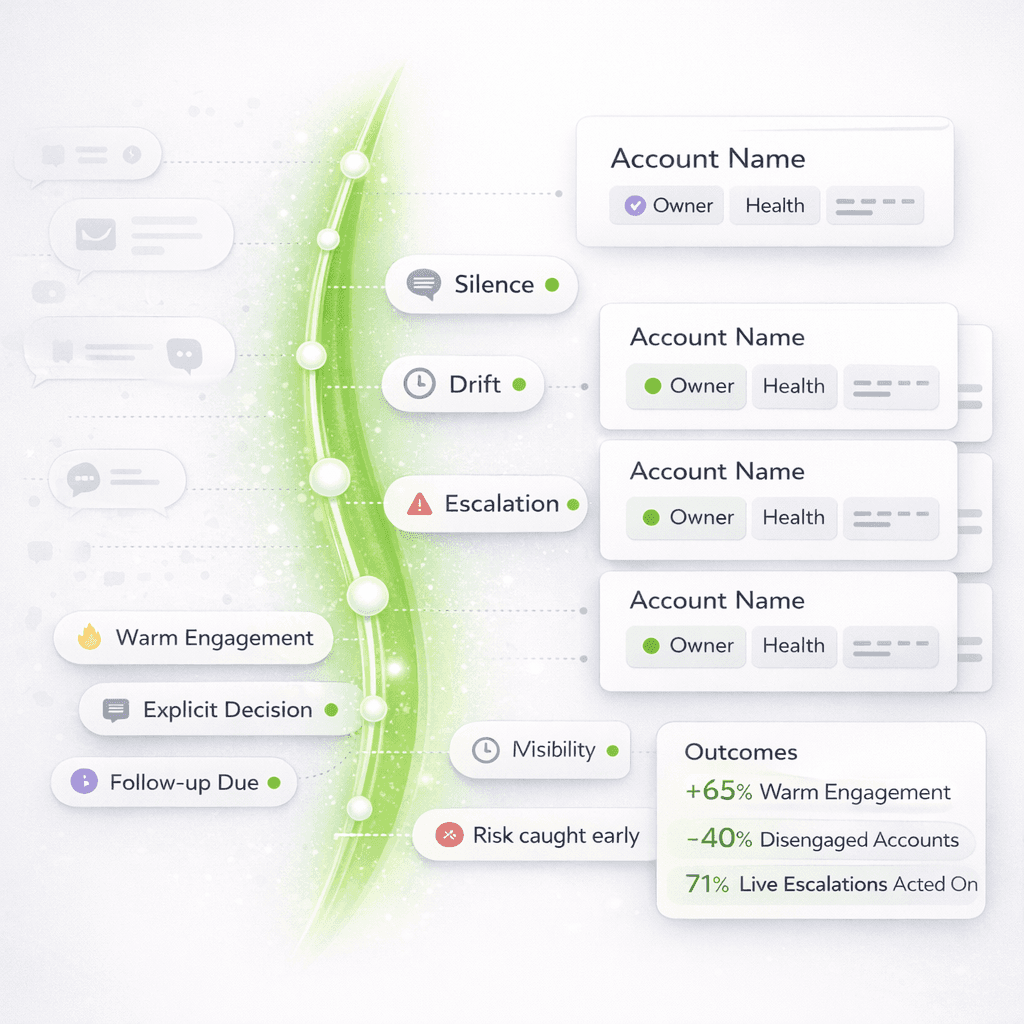
That is where Chetto’s conversation intelligence system comes in. By analyzing live signals across customer communication, it helps teams detect friction, silence, disengagement, and decision drift earlier.
We analyzed 2,000 client conversations through an experiment. Cohort A had access to Chetto’s dashboard; Cohort B did not. This gave us a way to compare what happens when teams can actually see client risk, disengagement, and decision signals in real time, versus when those signals stay hidden inside day-to-day conversations.cohort analysis, that shift showed up in stronger engagement quality, more explicit decisions, earlier risk visibility, and a 2.8x improvement in win rate.
Activity does not equal intent. The teams that win are the ones that catch momentum loss early, push for clarity, and focus their energy where the relationship is still recoverable.
Stop Guessing, Start Listening: Drive 65% Higher Warm Engagement
One of the easiest traps in client relationship management is assuming that visible activity means a relationship is healthy.
A rep sends a follow-up. A client replies politely. Another message goes out. A reminder is scheduled. On paper, the account looks active.
But activity alone does not tell you whether a buyer is leaning in or drifting away.
The real signal is in the quality of the response.
Are clients acknowledging the value of the conversation? Are they showing commitment? Are they engaging with intent? Or are they just sending polite replies that keep the thread alive without moving anything forward?
That difference matters because teams do not lose momentum all at once. Momentum fades gradually, and the clues usually show up in the tone and substance of replies long before the deal is marked at risk.
In Cohort A (one using chetto) a 22.4% warm engagement rate, compared with 13.4% in the comparison group, that meant about 65% higher warm engagement
That is what customer-centric client relationship management looks like. Instead of asking, How many follow-ups did we send? teams start asking, Which accounts are actually warming up, and which ones are cooling off?
That shift saves time. It helps reps prioritise better. And it prevents leaders from confusing busyness with progress.
Catch the Silence Before the Deal Goes Cold (40% Fewer Disengaged Accounts)
Silence is not neutral.
In high-touch sales and retention environments, silence is often the first sign that a conversation is slipping out of reach. A client who was engaged last week becomes vague. A thread that had momentum suddenly slows down. A promised response never comes. The deal does not die loudly. It drifts quietly.
That is what makes silence so expensive.
By the time an account is clearly lost, teams have often already spent too much time on it. Forecasts get distorted. Energy gets misallocated. And leadership ends up reviewing deals after the fact instead of rescuing them while recovery is still possible.
Conversation intelligence changes that timing.
Instead of discovering risk after the outcome is already obvious, teams can detect the early signs of silence, low engagement, and drift while the relationship is still live.
For modern client relationship management, this is one of the most important operating shifts: silence becomes a signal, not a mystery.
Don’t Just Surface Risk—Rescue the Deal: How Top Teams Acted on 71% of Live Escalations
High-performing teams don't just identify risk; they neutralize it mid-flight. While reactive teams perform autopsies, elite cohorts prioritize immediate intervention. Our data shows that top performers acted on 71% of escalations while deals were still live, compared to just 27.3% in the comparison group.
Crucially, the "too late" metric—escalations surfacing only after a deal was already lost—dropped significantly for high-performing teams. By shifting from post-mortems to active recovery, these teams turn red flags into live rescue signals. This allows leaders to intervene when the outcome can still be changed, rather than simply reconstructing why it failed.
The goal isn't to know why you lost; it's to ensure you don't. Turning early escalations into immediate actions is the shortest path to predictable revenue.
Kill the "Maybe": Drive 60% More Explicit Decisions to Clear Pipeline Limbo
Pipeline limbo is the ultimate hidden tax on productivity. When deals drift without a clear "Yes" or "No," teams waste resources on hope rather than strategy. Our data shows that elite teams don’t just wait for clarity—they force it. In the high-performance cohort, 28.6% of deals resulted in an explicit, documented decision, a 60% improvement over the comparison group. By identifying fading momentum early, these teams aggressively pushed for finality, reducing "no-decision" outcomes to 71.4%. Instead of allowing accounts to stall, they prioritized immediate resolution to keep the forecast clean and focused.
A "No" is a gift of time, while a "Maybe" is a drain on growth. By accelerating the path to an explicit decision, teams stop managing ghosts and start mastering their actual pipeline. Success isn't about keeping every deal alive—it's about getting to the truth fast enough to act on it.
Beyond Reporting: How Strategic Intervention Drives 2.8x Higher Win Rates
When teams preempt silence and neutralize risk in real-time, the results don’t just add up—they compound. Our data proves this transition from observation to intervention drives a 2.8x increase in wins per decided deal. By maintaining 65% higher warm engagement and slashing disengagement by 40%, top performers secured a 14.3% win rate, dwarfing the 5.1% achieved by reactive cohorts. This isn't just "better management"; it’s a high-performance engine that forces clarity. By doubling the rate of explicit decisions, teams stop guessing and start winning, proving that intelligence is only valuable when it dictates the next move.
What Modern Client Relationship Management Actually Looks Like
The goal is not to monitor people more.
The goal is to make momentum, risk, silence, and intent more visible.
When that visibility improves, teams do not need to chase vanity metrics. They do not need endless status meetings to figure out which accounts are real. And they do not need to wait for formal escalations to know something is slipping.
They can focus on what actually matters:
Which accounts are warming up
Which conversations are losing momentum
Which clients are drifting into silence
Which deals need a push toward clarity
Which risks are still recoverable
That is a much better operating model for retention and revenue.
It reduces wasted time for reps.
It reduces uncertainty for leaders.
And it improves the quality of client relationship management itself.
Final Thought
Poor client relationship management rarely fails in one dramatic moment.
It fails slowly.
A conversation cools off.
A client stops replying.
A deal stays open without moving.
An escalation surfaces too late.
A team stays busy, but the relationship is already slipping.
The best teams do not solve that problem by asking for more activity. They solve it by making customer conversations easier to understand in real time.
That is what Chetto is built for.
Chetto’s conversation intelligence system helps teams catch early warning signs, reduce silent drift, surface risk sooner, and drive clearer decisions across customer relationships. In practice, that means less time wasted in pipeline limbo, better prioritization for teams, and stronger retention outcomes for the business.
Metric | High-Performance (Cohort A) | Comparison (Cohort B) | Delta / Narrative Impact |
Live Escalations | 71% (Adjusted for "Action") | 27.30% | 2.6x more live interventions |
Post-Loss Escalations | 29% | 72.70% | Massive reduction in "too late" risks |
Explicit Decisions | 28.60% | 17.90% | 60% higher clarity |
Win Rate (Decided) | 14.30% | 5.10% | 2.8x higher win rate |
What Modern Client Relationship Management Actually Looks Like
The goal is not to monitor people; the goal is to make momentum, risk, silence, and intent visible.
When visibility improves, teams stop chasing vanity metrics. They don't need endless status meetings to figure out which accounts are "real," and they don't have to wait for formal escalations to know a deal is slipping. Instead, they focus on the signals that actually drive revenue:
Warmth: Which accounts are genuinely heating up?
Momentum: Where is the conversation losing its pulse?
Silence: Which clients are drifting into the "danger zone"?
Clarity: Which deals need a decisive push toward a "Yes" or a "No"?
Recovery: Which risks are still live enough to be rescued?
This is a superior operating model for retention. It replaces rep fatigue with focus, eliminates leadership uncertainty, and elevates the entire standard of client management.
Final Thought
Relationship failure rarely happens in one dramatic moment. It fails slowly. A conversation cools. A client stops replying. A deal stays open but stops moving. An escalation surfaces only after the loss. The team stays busy, but the relationship has already slipped away.
The best teams don't solve this by demanding more activity; they solve it by making customer conversations transparent in real-time. That is exactly what Chetto is built for.
FAQ's
1.What is conversation intelligence?
Conversation intelligence uses AI to analyze business communication/conversations across calls, meetings, emails, chats, and customer interactions to surface actionable insight such as ownership, risk, follow-ups, and next steps.
2.How do I see a client's full history if they use WhatsApp, email, and phone?
Chetto unifies every fragmented thread into a single, centralized timeline. Instead of digging through different apps to reconstruct a conversation, your team has instant access to the entire interaction history in one place.
3.Can my coordinators actually collaborate on the same WhatsApp chat?
Yes. Chetto transforms private, siloed messages into a shared team inbox. This allows multiple staff members to view, assign, and respond to the same conversation with full context, ensuring no client is left waiting.
4.How does this specifically help stop "Revenue Leakage"?
Revenue leaks when deals "drift" into silence unnoticed. Chetto identifies fading momentum and zero-message drops in real-time. By flagging these risks while the deal is still live, your team can intervene and rescue the revenue before the client goes cold.
5.How do I get oversight if my staff handles chats separately across different branches?
Chetto provides a birds-eye view of all client communications across your entire organization. Leaders can see which accounts are warming up and which are stalling, allowing you to manage by exception rather than hovering over every single chat.
6.Is this just another CRM that requires manual data entry?
No. While CRMs are for record-keeping, Chetto is for active intervention. It works in the background to capture the "real" conversation—the nuance, tone, and timing—so your team spends less time updating records and more time closing deals.
The Bottom Line: Chetto turns your fragmented communication channels into a single, high-velocity engine for growth.
Read more about our findings here

Blog written by
Muskan Dhadda
Product Designer
Muskan Dhadda is a product designer with a strong interest in user experience, systems thinking, and thoughtful visual design. She enjoys understanding the “why” behind products and turning ideas, patterns, and complexity into clear, practical experiences.
Blog written by
Muskan Dhadda
Product Designer
Muskan Dhadda is a product designer with a strong interest in user experience, systems thinking, and thoughtful visual design. She enjoys understanding the “why” behind products and turning ideas, patterns, and complexity into clear, practical experiences.
The most dangerous word in client relationship management is not no. It is maybe.
Maybe they are still interested.
Maybe the deal is alive.
Maybe the client just needs a few more days.
Maybe the silence does not mean anything.
That kind of ambiguity drains teams. Reps waste time chasing accounts that have already lost momentum. Leaders look at a pipeline that appears full but feels unpredictable. Customer-facing teams stay busy, but not always productive.
That is the real problem with traditional client relationship management. It tends to reward visible activity instead of real progress.
More follow-ups do not always mean stronger relationships. More messages do not always mean higher intent. And more meetings do not always mean an account is moving forward.
Modern teams need something better: a way to understand what is actually happening inside client conversations while there is still time to do something about it.
That is where Chetto’s conversation intelligence system comes in. By analyzing live signals across customer communication, it helps teams detect friction, silence, disengagement, and decision drift earlier.
We analyzed 2,000 client conversations through an experiment. Cohort A had access to Chetto’s dashboard; Cohort B did not. This gave us a way to compare what happens when teams can actually see client risk, disengagement, and decision signals in real time, versus when those signals stay hidden inside day-to-day conversations.cohort analysis, that shift showed up in stronger engagement quality, more explicit decisions, earlier risk visibility, and a 2.8x improvement in win rate.
Activity does not equal intent. The teams that win are the ones that catch momentum loss early, push for clarity, and focus their energy where the relationship is still recoverable.
Stop Guessing, Start Listening: Drive 65% Higher Warm Engagement
One of the easiest traps in client relationship management is assuming that visible activity means a relationship is healthy.
A rep sends a follow-up. A client replies politely. Another message goes out. A reminder is scheduled. On paper, the account looks active.
But activity alone does not tell you whether a buyer is leaning in or drifting away.
The real signal is in the quality of the response.
Are clients acknowledging the value of the conversation? Are they showing commitment? Are they engaging with intent? Or are they just sending polite replies that keep the thread alive without moving anything forward?
That difference matters because teams do not lose momentum all at once. Momentum fades gradually, and the clues usually show up in the tone and substance of replies long before the deal is marked at risk.
In Cohort A (one using chetto) a 22.4% warm engagement rate, compared with 13.4% in the comparison group, that meant about 65% higher warm engagement
That is what customer-centric client relationship management looks like. Instead of asking, How many follow-ups did we send? teams start asking, Which accounts are actually warming up, and which ones are cooling off?
That shift saves time. It helps reps prioritise better. And it prevents leaders from confusing busyness with progress.
Catch the Silence Before the Deal Goes Cold (40% Fewer Disengaged Accounts)
Silence is not neutral.
In high-touch sales and retention environments, silence is often the first sign that a conversation is slipping out of reach. A client who was engaged last week becomes vague. A thread that had momentum suddenly slows down. A promised response never comes. The deal does not die loudly. It drifts quietly.
That is what makes silence so expensive.
By the time an account is clearly lost, teams have often already spent too much time on it. Forecasts get distorted. Energy gets misallocated. And leadership ends up reviewing deals after the fact instead of rescuing them while recovery is still possible.
Conversation intelligence changes that timing.
Instead of discovering risk after the outcome is already obvious, teams can detect the early signs of silence, low engagement, and drift while the relationship is still live.
For modern client relationship management, this is one of the most important operating shifts: silence becomes a signal, not a mystery.
Don’t Just Surface Risk—Rescue the Deal: How Top Teams Acted on 71% of Live Escalations
High-performing teams don't just identify risk; they neutralize it mid-flight. While reactive teams perform autopsies, elite cohorts prioritize immediate intervention. Our data shows that top performers acted on 71% of escalations while deals were still live, compared to just 27.3% in the comparison group.
Crucially, the "too late" metric—escalations surfacing only after a deal was already lost—dropped significantly for high-performing teams. By shifting from post-mortems to active recovery, these teams turn red flags into live rescue signals. This allows leaders to intervene when the outcome can still be changed, rather than simply reconstructing why it failed.
The goal isn't to know why you lost; it's to ensure you don't. Turning early escalations into immediate actions is the shortest path to predictable revenue.
Kill the "Maybe": Drive 60% More Explicit Decisions to Clear Pipeline Limbo
Pipeline limbo is the ultimate hidden tax on productivity. When deals drift without a clear "Yes" or "No," teams waste resources on hope rather than strategy. Our data shows that elite teams don’t just wait for clarity—they force it. In the high-performance cohort, 28.6% of deals resulted in an explicit, documented decision, a 60% improvement over the comparison group. By identifying fading momentum early, these teams aggressively pushed for finality, reducing "no-decision" outcomes to 71.4%. Instead of allowing accounts to stall, they prioritized immediate resolution to keep the forecast clean and focused.
A "No" is a gift of time, while a "Maybe" is a drain on growth. By accelerating the path to an explicit decision, teams stop managing ghosts and start mastering their actual pipeline. Success isn't about keeping every deal alive—it's about getting to the truth fast enough to act on it.
Beyond Reporting: How Strategic Intervention Drives 2.8x Higher Win Rates
When teams preempt silence and neutralize risk in real-time, the results don’t just add up—they compound. Our data proves this transition from observation to intervention drives a 2.8x increase in wins per decided deal. By maintaining 65% higher warm engagement and slashing disengagement by 40%, top performers secured a 14.3% win rate, dwarfing the 5.1% achieved by reactive cohorts. This isn't just "better management"; it’s a high-performance engine that forces clarity. By doubling the rate of explicit decisions, teams stop guessing and start winning, proving that intelligence is only valuable when it dictates the next move.
What Modern Client Relationship Management Actually Looks Like
The goal is not to monitor people more.
The goal is to make momentum, risk, silence, and intent more visible.
When that visibility improves, teams do not need to chase vanity metrics. They do not need endless status meetings to figure out which accounts are real. And they do not need to wait for formal escalations to know something is slipping.
They can focus on what actually matters:
Which accounts are warming up
Which conversations are losing momentum
Which clients are drifting into silence
Which deals need a push toward clarity
Which risks are still recoverable
That is a much better operating model for retention and revenue.
It reduces wasted time for reps.
It reduces uncertainty for leaders.
And it improves the quality of client relationship management itself.
Final Thought
Poor client relationship management rarely fails in one dramatic moment.
It fails slowly.
A conversation cools off.
A client stops replying.
A deal stays open without moving.
An escalation surfaces too late.
A team stays busy, but the relationship is already slipping.
The best teams do not solve that problem by asking for more activity. They solve it by making customer conversations easier to understand in real time.
That is what Chetto is built for.
Chetto’s conversation intelligence system helps teams catch early warning signs, reduce silent drift, surface risk sooner, and drive clearer decisions across customer relationships. In practice, that means less time wasted in pipeline limbo, better prioritization for teams, and stronger retention outcomes for the business.
Metric | High-Performance (Cohort A) | Comparison (Cohort B) | Delta / Narrative Impact |
Live Escalations | 71% (Adjusted for "Action") | 27.30% | 2.6x more live interventions |
Post-Loss Escalations | 29% | 72.70% | Massive reduction in "too late" risks |
Explicit Decisions | 28.60% | 17.90% | 60% higher clarity |
Win Rate (Decided) | 14.30% | 5.10% | 2.8x higher win rate |
What Modern Client Relationship Management Actually Looks Like
The goal is not to monitor people; the goal is to make momentum, risk, silence, and intent visible.
When visibility improves, teams stop chasing vanity metrics. They don't need endless status meetings to figure out which accounts are "real," and they don't have to wait for formal escalations to know a deal is slipping. Instead, they focus on the signals that actually drive revenue:
Warmth: Which accounts are genuinely heating up?
Momentum: Where is the conversation losing its pulse?
Silence: Which clients are drifting into the "danger zone"?
Clarity: Which deals need a decisive push toward a "Yes" or a "No"?
Recovery: Which risks are still live enough to be rescued?
This is a superior operating model for retention. It replaces rep fatigue with focus, eliminates leadership uncertainty, and elevates the entire standard of client management.
Final Thought
Relationship failure rarely happens in one dramatic moment. It fails slowly. A conversation cools. A client stops replying. A deal stays open but stops moving. An escalation surfaces only after the loss. The team stays busy, but the relationship has already slipped away.
The best teams don't solve this by demanding more activity; they solve it by making customer conversations transparent in real-time. That is exactly what Chetto is built for.
FAQ's
1.What is conversation intelligence?
Conversation intelligence uses AI to analyze business communication/conversations across calls, meetings, emails, chats, and customer interactions to surface actionable insight such as ownership, risk, follow-ups, and next steps.
2.How do I see a client's full history if they use WhatsApp, email, and phone?
Chetto unifies every fragmented thread into a single, centralized timeline. Instead of digging through different apps to reconstruct a conversation, your team has instant access to the entire interaction history in one place.
3.Can my coordinators actually collaborate on the same WhatsApp chat?
Yes. Chetto transforms private, siloed messages into a shared team inbox. This allows multiple staff members to view, assign, and respond to the same conversation with full context, ensuring no client is left waiting.
4.How does this specifically help stop "Revenue Leakage"?
Revenue leaks when deals "drift" into silence unnoticed. Chetto identifies fading momentum and zero-message drops in real-time. By flagging these risks while the deal is still live, your team can intervene and rescue the revenue before the client goes cold.
5.How do I get oversight if my staff handles chats separately across different branches?
Chetto provides a birds-eye view of all client communications across your entire organization. Leaders can see which accounts are warming up and which are stalling, allowing you to manage by exception rather than hovering over every single chat.
6.Is this just another CRM that requires manual data entry?
No. While CRMs are for record-keeping, Chetto is for active intervention. It works in the background to capture the "real" conversation—the nuance, tone, and timing—so your team spends less time updating records and more time closing deals.
The Bottom Line: Chetto turns your fragmented communication channels into a single, high-velocity engine for growth.
Read more about our findings here
Blog written by
Muskan Dhadda
Product Designer
Muskan Dhadda is a product designer with a strong interest in user experience, systems thinking, and thoughtful visual design. She enjoys understanding the “why” behind products and turning ideas, patterns, and complexity into clear, practical experiences.