Customer Escalation Meaning: The Messages That Hurt ACV Before Churn
Customer Escalation Meaning: The Messages That Hurt ACV Before Churn
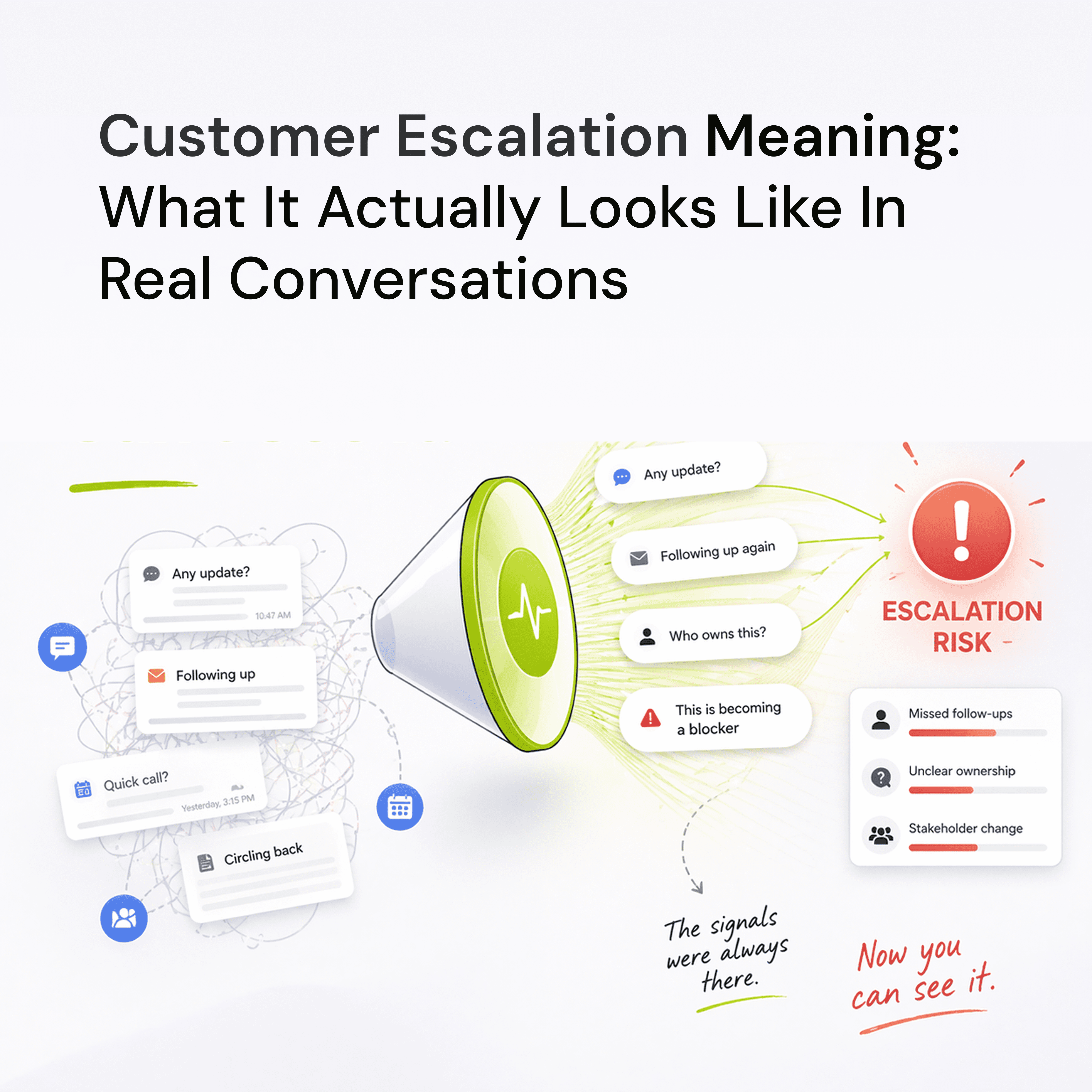
Customer escalation does not always start with “I want to escalate this.”
It often starts with ordinary messages like:
“Any update?”
“This was promised last week.”
“Why are we being charged?”
“This is still not working.”
“Can someone senior look into this?”
When these signals repeat across email, Slack, WhatsApp, calls, and meetings, they damage trust and expose ACV.
That is the real meaning of customer escalation: a normal customer issue becoming a trust, urgency, or ownership problem that can lead to churn, refunds, negative reviews, or lost revenue.
Customer Escalation Is Usually a Revenue Signal
A study of real customer escalation conversations shows that ACV risk usually appears in specific kinds of messages.
The strongest escalation signals often fall into these categories:
Commitment breach
Billing and finance issues
Technical failure
Quality defect
Relationship risk
Delivery delay
Unresponsive teams
Refund or cancellation requests
Legal or compliance concerns
Public complaints and negative reviews
These are not just support issues.
They are revenue-risk signals.
1. Commitment Breach: “You Said This Would Be Done”
One of the clearest escalation signals is a broken promise.
Customers may say:
“This was committed for last week.”
“You said this would be ready by Friday.”
“This is not what was agreed.”
“We planned around your timeline.”
Why this hurts ACV:
A missed commitment makes the customer question whether your team can be trusted with future work, expansion, or renewal.
2. Billing and Finance: “Why Are We Paying for This?”
Billing issues escalate quickly because they connect directly to value.
Customers may say:
“Why have we been charged for this?”
“This invoice does not match what was agreed.”
“We are not approving this payment until this is clarified.”
Why this hurts ACV:
Once a customer questions charges, the conversation shifts from service delivery to value justification. That can delay renewals, block expansion, or trigger refund requests.
3. Technical Failure: “This Is Still Not Working”
Technical problems become escalation when they block customer work.
Customers may say:
“This feature is broken again.”
“We are unable to use this.”
“This is blocking our team.”
“We cannot move forward until this is fixed.”
Why this hurts ACV:
If the product does not work when the customer needs it, usage drops. When usage drops, renewal risk increases.
4. Quality Defect: “This Is Not Good Enough”
Quality complaints make customers question the standard of work.
Customers may say:
“This needs to be changed completely.”
“This is not acceptable quality.”
“This does not match what we approved.”
“The output is not usable.”
Why this hurts ACV:
Quality issues create doubt. The customer may slow expansion, compare alternatives, or involve senior stakeholders.
5. Relationship Risk: “We Are Losing Confidence”
This is where escalation becomes dangerous.
Customers may say:
“This is affecting our confidence.”
“We are not happy with how this has been handled.”
“This is becoming difficult to justify internally.”
“We may need to reconsider our options.”
Why this hurts ACV:
At this stage, the customer is no longer only questioning the issue. They are questioning the relationship.
6. Delivery Delay: “We Needed This Earlier”
Delays become escalation when they affect the customer’s timeline.
Customers may say:
“This delay is affecting our launch.”
“We have been waiting for 10 days.”
“This was supposed to be completed already.”
“We cannot keep pushing our timeline.”
Why this hurts ACV:
A delay affects more than delivery. It affects the customer’s planning, credibility, and business outcome.
7. Unresponsive Teams: “Is Anyone Looking at This?”
Silence is one of the easiest ways to turn a small issue into escalation.
Customers may say:
“Any update?”
“Following up again.”
“Can someone please respond?”
“Who is owning this?”
“We have not heard back on this.”
Why this hurts ACV:
Customers can forgive problems. They are less likely to forgive feeling ignored.
8. Refund or Cancellation: “We Want to Stop”
This is direct revenue risk.
Customers may say:
“We would like a refund.”
“Please cancel our subscription.”
“We do not want to continue.”
“This is not worth the cost.”
“We are evaluating other options.”
Why this hurts ACV:
At this point, the team is no longer preventing escalation. They are trying to recover the relationship.
9. Legal or Compliance: “We Need to Escalate This Formally”
Legal or compliance language usually means the customer has lost patience.
Customers may say:
“We may need to involve legal.”
“Please treat this as a formal notice.”
“This is a compliance concern.”
“We need this documented.”
Why this hurts ACV:
Once the issue becomes formal, the risk moves beyond customer success. It can involve leadership, finance, legal, and reputation.
10. Public Reviews and Social Media: “People Should Know About This”
This is the stage many teams notice too late.
By the time a customer posts publicly or leaves a negative review, the escalation has usually already happened privately.
They may have already sent messages like:
“We raised this earlier.”
“Nobody has responded.”
“This has still not been fixed.”
“We were promised a resolution.”
“We are tired of following up.”
When those private signals are missed, the customer may take the issue public.
Public messages may look like:
“Terrible experience. We kept following up and nobody responded.”
“They promised delivery and missed every timeline.”
“We were charged incorrectly and still have no resolution.”
“The product did not work as promised.”
“Support kept saying they would check, but nothing happened.”
“Avoid this if you care about response times.”
“Great sales pitch, poor follow-through.”
“We had to chase them for every update.”
“Not worth the money.”
“Would not recommend.”
This hurts ACV in two ways.
First, the existing customer becomes a churn or refund risk.
Second, future customers may see the review before buying. A negative LinkedIn post, Google review, G2 review, Reddit thread, app store review, or public complaint can create doubt before a sales conversation even starts.
One missed escalation does not only affect one account. It can affect pipeline, conversion, renewals, expansion, and brand trust.
That is how a private customer issue becomes a public ACV problem.
Why These Messages Are Easy to Miss
The problem is not that teams do not care.
The problem is that escalation signals are scattered.
One message is in email.
One follow-up is in Slack.
One complaint is on WhatsApp.
One concern comes up in a call.
One customer comment appears on social media.
One internal owner says they will check.
Then nothing happens.
Everyone sees one part of the story.
Nobody sees the full risk pattern.
That is how ACV gets hurt quietly.
Customer Escalation Meaning in One Line
Customer escalation is when a customer message signals that trust, value, delivery, or ownership is breaking down.
It may look like:
“This was promised.”
“This is still broken.”
“This invoice is wrong.”
“Nobody is responding.”
“We want a refund.”
“We may need to escalate this formally.”
“People should know about this.”
These are not just support messages.
They are ACV risk signals.
Where Chetto Fits
Chetto helps teams detect customer escalation signals before they become churn, refund, legal, or public reputation problems.
It connects customer conversations across email, Slack, WhatsApp, meetings, and other channels, helping teams identify:
Commitment breaches
Billing and finance issues
Technical failures
Quality defects
Relationship risk
Delivery delays
Unanswered follow-ups
Refund or cancellation signals
Legal and compliance risks
Public complaint patterns
Because ACV risk is rarely hidden.
It is usually sitting inside customer messages.
The real challenge is seeing it before it becomes a lost customer, a negative review, or a public complaint.
FAQs
What is conversation intelligence?
Conversation intelligence uses AI to analyze business communication/conversations across calls, meetings, emails, chats, and customer interactions to surface actionable insight such as ownership, risk, follow-ups, and next steps.
What is customer escalation?
Customer escalation is when a customer issue becomes urgent, unresolved, or serious enough to require faster action, clearer ownership, or senior involvement.
How does customer escalation hurt ACV?
Customer escalation hurts ACV by reducing trust, delaying renewals, blocking expansion, triggering refund requests, increasing churn risk, or pushing customers to evaluate alternatives.
How do negative reviews hurt ACV?
Negative reviews hurt ACV by damaging trust before the sales conversation starts. They can reduce conversion, slow pipeline, create renewal concerns, and make future customers question the reliability of the product or service.
What are common customer escalation messages?
Common escalation messages include “Any update?”, “This was promised last week,” “This is still not working,” “We want a refund,” “We may need to involve legal,” and “People should know about this.”

Blog written by
Muskan Dhadda
Product Designer
Muskan Dhadda is a product designer with a strong interest in user experience, systems thinking, and thoughtful visual design. She enjoys understanding the “why” behind products and turning ideas, patterns, and complexity into clear, practical experiences.
Blog written by
Muskan Dhadda
Product Designer
Muskan Dhadda is a product designer with a strong interest in user experience, systems thinking, and thoughtful visual design. She enjoys understanding the “why” behind products and turning ideas, patterns, and complexity into clear, practical experiences.
Customer escalation does not always start with “I want to escalate this.”
It often starts with ordinary messages like:
“Any update?”
“This was promised last week.”
“Why are we being charged?”
“This is still not working.”
“Can someone senior look into this?”
When these signals repeat across email, Slack, WhatsApp, calls, and meetings, they damage trust and expose ACV.
That is the real meaning of customer escalation: a normal customer issue becoming a trust, urgency, or ownership problem that can lead to churn, refunds, negative reviews, or lost revenue.
Customer Escalation Is Usually a Revenue Signal
A study of real customer escalation conversations shows that ACV risk usually appears in specific kinds of messages.
The strongest escalation signals often fall into these categories:
Commitment breach
Billing and finance issues
Technical failure
Quality defect
Relationship risk
Delivery delay
Unresponsive teams
Refund or cancellation requests
Legal or compliance concerns
Public complaints and negative reviews
These are not just support issues.
They are revenue-risk signals.
1. Commitment Breach: “You Said This Would Be Done”
One of the clearest escalation signals is a broken promise.
Customers may say:
“This was committed for last week.”
“You said this would be ready by Friday.”
“This is not what was agreed.”
“We planned around your timeline.”
Why this hurts ACV:
A missed commitment makes the customer question whether your team can be trusted with future work, expansion, or renewal.
2. Billing and Finance: “Why Are We Paying for This?”
Billing issues escalate quickly because they connect directly to value.
Customers may say:
“Why have we been charged for this?”
“This invoice does not match what was agreed.”
“We are not approving this payment until this is clarified.”
Why this hurts ACV:
Once a customer questions charges, the conversation shifts from service delivery to value justification. That can delay renewals, block expansion, or trigger refund requests.
3. Technical Failure: “This Is Still Not Working”
Technical problems become escalation when they block customer work.
Customers may say:
“This feature is broken again.”
“We are unable to use this.”
“This is blocking our team.”
“We cannot move forward until this is fixed.”
Why this hurts ACV:
If the product does not work when the customer needs it, usage drops. When usage drops, renewal risk increases.
4. Quality Defect: “This Is Not Good Enough”
Quality complaints make customers question the standard of work.
Customers may say:
“This needs to be changed completely.”
“This is not acceptable quality.”
“This does not match what we approved.”
“The output is not usable.”
Why this hurts ACV:
Quality issues create doubt. The customer may slow expansion, compare alternatives, or involve senior stakeholders.
5. Relationship Risk: “We Are Losing Confidence”
This is where escalation becomes dangerous.
Customers may say:
“This is affecting our confidence.”
“We are not happy with how this has been handled.”
“This is becoming difficult to justify internally.”
“We may need to reconsider our options.”
Why this hurts ACV:
At this stage, the customer is no longer only questioning the issue. They are questioning the relationship.
6. Delivery Delay: “We Needed This Earlier”
Delays become escalation when they affect the customer’s timeline.
Customers may say:
“This delay is affecting our launch.”
“We have been waiting for 10 days.”
“This was supposed to be completed already.”
“We cannot keep pushing our timeline.”
Why this hurts ACV:
A delay affects more than delivery. It affects the customer’s planning, credibility, and business outcome.
7. Unresponsive Teams: “Is Anyone Looking at This?”
Silence is one of the easiest ways to turn a small issue into escalation.
Customers may say:
“Any update?”
“Following up again.”
“Can someone please respond?”
“Who is owning this?”
“We have not heard back on this.”
Why this hurts ACV:
Customers can forgive problems. They are less likely to forgive feeling ignored.
8. Refund or Cancellation: “We Want to Stop”
This is direct revenue risk.
Customers may say:
“We would like a refund.”
“Please cancel our subscription.”
“We do not want to continue.”
“This is not worth the cost.”
“We are evaluating other options.”
Why this hurts ACV:
At this point, the team is no longer preventing escalation. They are trying to recover the relationship.
9. Legal or Compliance: “We Need to Escalate This Formally”
Legal or compliance language usually means the customer has lost patience.
Customers may say:
“We may need to involve legal.”
“Please treat this as a formal notice.”
“This is a compliance concern.”
“We need this documented.”
Why this hurts ACV:
Once the issue becomes formal, the risk moves beyond customer success. It can involve leadership, finance, legal, and reputation.
10. Public Reviews and Social Media: “People Should Know About This”
This is the stage many teams notice too late.
By the time a customer posts publicly or leaves a negative review, the escalation has usually already happened privately.
They may have already sent messages like:
“We raised this earlier.”
“Nobody has responded.”
“This has still not been fixed.”
“We were promised a resolution.”
“We are tired of following up.”
When those private signals are missed, the customer may take the issue public.
Public messages may look like:
“Terrible experience. We kept following up and nobody responded.”
“They promised delivery and missed every timeline.”
“We were charged incorrectly and still have no resolution.”
“The product did not work as promised.”
“Support kept saying they would check, but nothing happened.”
“Avoid this if you care about response times.”
“Great sales pitch, poor follow-through.”
“We had to chase them for every update.”
“Not worth the money.”
“Would not recommend.”
This hurts ACV in two ways.
First, the existing customer becomes a churn or refund risk.
Second, future customers may see the review before buying. A negative LinkedIn post, Google review, G2 review, Reddit thread, app store review, or public complaint can create doubt before a sales conversation even starts.
One missed escalation does not only affect one account. It can affect pipeline, conversion, renewals, expansion, and brand trust.
That is how a private customer issue becomes a public ACV problem.
Why These Messages Are Easy to Miss
The problem is not that teams do not care.
The problem is that escalation signals are scattered.
One message is in email.
One follow-up is in Slack.
One complaint is on WhatsApp.
One concern comes up in a call.
One customer comment appears on social media.
One internal owner says they will check.
Then nothing happens.
Everyone sees one part of the story.
Nobody sees the full risk pattern.
That is how ACV gets hurt quietly.
Customer Escalation Meaning in One Line
Customer escalation is when a customer message signals that trust, value, delivery, or ownership is breaking down.
It may look like:
“This was promised.”
“This is still broken.”
“This invoice is wrong.”
“Nobody is responding.”
“We want a refund.”
“We may need to escalate this formally.”
“People should know about this.”
These are not just support messages.
They are ACV risk signals.
Where Chetto Fits
Chetto helps teams detect customer escalation signals before they become churn, refund, legal, or public reputation problems.
It connects customer conversations across email, Slack, WhatsApp, meetings, and other channels, helping teams identify:
Commitment breaches
Billing and finance issues
Technical failures
Quality defects
Relationship risk
Delivery delays
Unanswered follow-ups
Refund or cancellation signals
Legal and compliance risks
Public complaint patterns
Because ACV risk is rarely hidden.
It is usually sitting inside customer messages.
The real challenge is seeing it before it becomes a lost customer, a negative review, or a public complaint.
FAQs
What is conversation intelligence?
Conversation intelligence uses AI to analyze business communication/conversations across calls, meetings, emails, chats, and customer interactions to surface actionable insight such as ownership, risk, follow-ups, and next steps.
What is customer escalation?
Customer escalation is when a customer issue becomes urgent, unresolved, or serious enough to require faster action, clearer ownership, or senior involvement.
How does customer escalation hurt ACV?
Customer escalation hurts ACV by reducing trust, delaying renewals, blocking expansion, triggering refund requests, increasing churn risk, or pushing customers to evaluate alternatives.
How do negative reviews hurt ACV?
Negative reviews hurt ACV by damaging trust before the sales conversation starts. They can reduce conversion, slow pipeline, create renewal concerns, and make future customers question the reliability of the product or service.
What are common customer escalation messages?
Common escalation messages include “Any update?”, “This was promised last week,” “This is still not working,” “We want a refund,” “We may need to involve legal,” and “People should know about this.”
Blog written by
Muskan Dhadda
Product Designer
Muskan Dhadda is a product designer with a strong interest in user experience, systems thinking, and thoughtful visual design. She enjoys understanding the “why” behind products and turning ideas, patterns, and complexity into clear, practical experiences.